Ambulances are called to beauty clinics every 13 hours in the UK
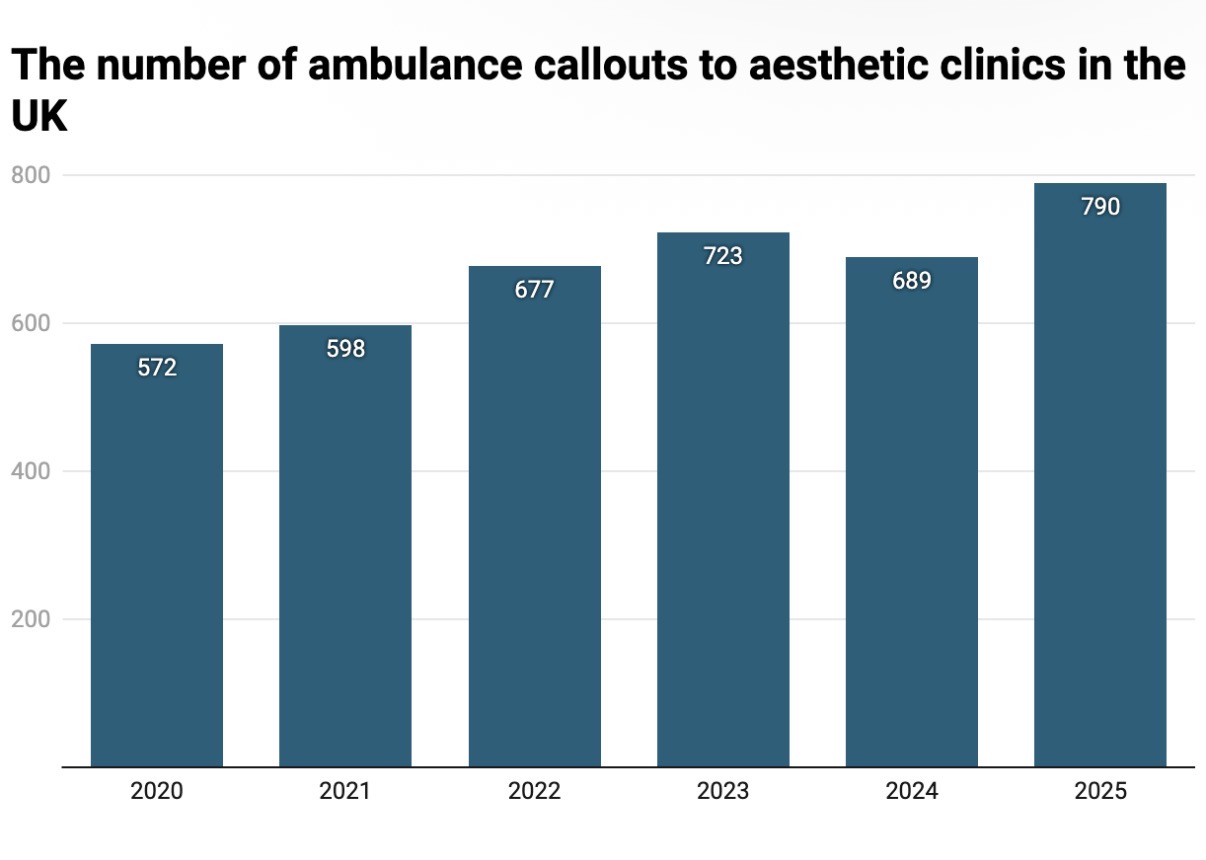
ZAVA’s FOI request has revealed that from 2020 to 2025, there has been a 38% increase in ambulance callouts to beauty clinics, soaring from 572 incidents in 2020 to 790 in 2025, totalling 4,049 emergencies at beauty clinics in six years, the equivalent of one ambulance called every 13 hours.
Up to 31st March 2026, 90 incidents required ambulance response in 2026, with East Midlands Ambulance Service NHS Trust recording the most callouts at 24, more than double that of London, with just 11 calls.
London reported the most callouts with 739 from 2020 to 2025, seeing a 17.6% drop in callouts from 2020 to 2025, from 142 to 117. Meanwhile, East Midlands Ambulance Service NHS Trust reported the second most at 708, seeing a staggering increase of 115% from 73 to 157.
Many of the callouts made for UK ambulance services were due to allergic reactions, convulsions/fitting, chest pain, breathing issues and fainting or unconsciousness. East Midlands Ambulance Service NHS Trust responded to 84 callouts for unconsciousness or fainting, 52 for falls and 51 for convulsions or fitting between January 2020 and March 2026.
Botox carries a 16% complication rate, with bruising, headache, and facial paresis common
Minimally invasive beauty treatments such as dermal fillers and Botox carry risks. If placed incorrectly, dermal fillers can damage nearby arteries. Some risks include vascular occlusion, where filler is injected into or too close to blood vessels, which can cause tissue death and facial deformity. Other side effects from facial Botox include muscle stiffness, pain, dizziness, and even heart attacks.
One study found that there was a 16% complication rate with Botox, with the most common bad reactions including bruising (5%), headache (3%), and facial paresis (2%).
With the rise in popularity of GLP-1s, the aesthetics industry has seen an influx of weight-loss drug users seeking more aesthetic treatments to address concerns associated with weight loss, including skin laxity, skin quality, or facial fullness, often using dermal fillers to treat the concerns. Data shows that 20% of GLP-1 users have undergone plastic surgery, with 39% considering surgical treatment and 41% considering a nonsurgical procedure.
With beauty treatments linked to thousands of ambulance callouts, Dr Kathryn Basford at ZAVA warns:
“With obesity prevalent across the UK, impacting millions of Brits, in combination with societal pressures to fit beauty standards and the rising costs of living, we are seeing many Brits turn to dangerous procedures and unregulated or even counterfeit products to get results, from weight loss to anti-ageing.
It is vital that those seeking aesthetic or weight-loss treatments see a qualified healthcare practitioner before starting treatment to ensure their treatment is safe, regulated and will be administered correctly and with care.
If purchasing weight-loss injections online, before making a purchase, always check for the pharmacy’s General Pharmaceutical Council (GPhC) registration number and verify it on the GPhC website to confirm the pharmacy is properly regulated and meets guidelines.”
Counterfeit Botox and weight-loss medications surge in popularity in the UK – risking thousands of lives.
The Medicines and Healthcare products Regulatory Agency (MHRA) has reported that between 4 June and 6 August 2025, 41 cases of botulism were confirmed from Botox. The rare and potentially life-threatening condition causing paralysis was reported across England, including the North East, East Midlands, East of England, North West, and Yorkshire and Humber. The Criminal Enforcement Unit has reported evidence that some UK sellers and practitioners, many untrained, are using unlicensed botulinum toxin and also administering the injections in unsafe settings, even domestic kitchens, bedrooms and hair salons.
Recent FOI data reveals that 18,316 illegal or unregulated weight loss and diabetes medications were seized at UK borders from January 2024 to June 2025 – equating to around 34 medications every day.
This year has also seen the Medicines and Healthcare products Regulatory Agency crack down on the illegal supply of weight loss medicines, with the largest ever seizure on 28th May 2026 resulting in the recovery of 12,000 doses of unlicensed weight loss medicines in Northamptonshire, where the manufacture and distribution of medications, including retatrutide, tirzepatide, and other synthetic peptides, took place.
Dangerous procedures like Lemon Bottle injections and Brazilian butt lifts surge in popularity in the UK
ZAVA’s FOI request has also revealed that from 2020 to 2025, UK ambulances have responded to 9,395 emergencies linked to weight-loss procedures and medications, including Brazilian butt lifts, Lemon Bottle, fat-dissolving products, and weight-loss injections, the equivalent of one call every 5 hours and 35 minutes.
Procedures like Brazilian butt lifts (BBLs) are designed to increase the size of the buttocks and are performed either via fat transfer or synthetic fillers.
These procedures are incredibly popular across the UK and US, but aren’t without significant risks, so much so that the British Association of Aesthetic Plastic Surgeons (BAAPS) has advised its members to not carry out the procedure unless suitably trained, under ultrasound guidance and in CQC-regulated premises due to the risks due to the anatomical complexity of the buttocks. Complications from procedures include sepsis, severe bleeding, fat embolus, and even life-threatening complications.
Brits search for BBLs on Google 74,000 times a month, and with this huge interest, more practitioners are jumping on the trend, whether qualified to do so or not. Filler, in particular, is a popular, cheaper option for many patients. Pop-up clinics have been found across the UK to offer dangerous non-surgical BBL procedures, resulting in complications and even the death of Brits.
Over 500 Brits have sought help from the government-backed cosmetic watchdog Save Face for complications from liquid BBL procedures, with 50% reporting sepsis and 39% needing corrective surgery.
One Reddit user describes their experience with a liquid BBL gone wrong:
“I’ve always been pretty healthy and obsessed with the gym and making sure I have a good protein intake to gain healthy weight. I went from 100 pounds to 134. I’m very proud of myself. The only thing I didn’t like when I looked in the mirror was my hip dips. No matter how many workouts I did in the gym, my hips always went in just a bit. Someone told me about Liquid BBL filler this past Sunday. I got the procedure done, and I regret it so much. Let me first say that the results were beautiful.
After days of excruciating pain, I started to discharge. Nasty-smelling discharge coming from the sides of my hips on both sides. It has not been over a week, and it is still discharging.
I just went through surgery where they had to cut small incisions on my hip/buttock area and drain out all the nasty gunk. The CAT scans show I had a lot of inflammation and “bubbles” that they had to remove. The wounds will be nasty, but they had to do what they had to do to save me. I was, of course, put under local anesthesia. I woke up cold and cried so much. Never will I get this again. Right now I’m lying down on antibiotics and things to help ease my pain.
“I’m now discharged from the hospital. I’ve been there for almost a week. It wasn’t easy. I had to undergo surgery, which is where I was mostly drained. They gave me 3 (Holes) incisions on my hips and butt. They put some type of rubber through them like pipes so it could drain over time. The nurses would come and change it every day. I feel gross. I feel like a raisin. It’s like they sucked everything out of me.
I feel ruined. I cry every hour. I feel empty. I regret even taking advice from someone.”
This quote has been edited for clarity and spelling purposes.
Lemon Bottle, another popular choice offered to Brits in the name of weight loss, has been hailed as “fat-melting” and went from 0 Google Searches per month in June 2022 to 40,500 by October 2023 and now still garners 8,100 monthly Google searches from Brits looking for quick weight loss. Little is known about what Lemon Bottle injections contain, but it is marketed as a “natural” injectable that targets fat and reportedly contains bromelain, riboflavin and lecithin. In 2024, Swiss medicines regulator Swissmedic warned the public not to use Lemon Bottle and described it as having “no medicinal effect”.
This option is often advertised on social media channels like Instagram and even Facebook Marketplace for as little as £50. But this unregulated substance, called ‘Lemon Bottle’, can “potentially cause serious harm” according to the General Pharmaceutical Council (GPhC).