Drawing under water, stoats jumping on paintings and the world’s most dangerous bird posing for a portrait – top wildlife artists share their stories
Great wildlife art begins in the field, with artists often battling inclement weather and challenging conditions to closely observe and experience wild animals, birds and insects at first hand. These nature-based studios often give rise to artists encountering their wild models in the most surprising ways. To mark the opening of the Society of Wildlife Artists’ (SWLA) Annual Exhibition, “The Natural Eye” 2026, five member artists have shared some of their interesting ‘in the field’ stories. The exhibition opens on Thursday 1st October and runs until Saturday 10th. All work shown will be available to buy online and in-person. See here: https://www.mallgalleries.org.uk/exhibitions-events/society-wildlife-artists-natural-eye-2026
Harriet Mead, President of the SWLA for 16 years – and stepping down after this year’s exhibition – said; “Close observation in the field is the cornerstone of excellence in wildlife art. It is critical both to capturing the spirit of an animal and to depicting it with anatomical accuracy. Working with wild animals in this way can lead to both entertaining and life-enhancing experiences for our artists! However, what may be less obvious from these lovely stories, is how closely the roles of artist and naturalist can overlap. By studying wildlife and its habitats over many weeks, artists can record changes in the natural world that might otherwise go unnoticed. The work of many of our artists has raised awareness of vital issues such as biodiversity loss, while also documenting more hopeful discoveries, including the recovery of threatened species.”
The world’s most dangerous bird sits for a portrait – Joris De Raedt ASWLA
Standing as high as six feet, and weighing up to 160 pounds, Cassowaries are often described as the world’s most dangerous birds. When I was working on illustrations for a biology textbook in Australia I had already seen how seriously locals treated them. On one occasion, I watched people simply abandon their picnic when a cassowary arrived, rather than risk interfering with the bird. A few years later, I had a close encounter in the Atherton Tablelands. While sketching at the edge of the rainforest, I found myself being chased by a young cassowary. In areas where they are regularly fed by people, cassowaries can begin to associate humans with food, sometimes creating dangerous situations. Fortunately, this one seemed more curious than aggressive. Once the excitement had passed, it lingered nearby and became an unexpectedly cooperative subject for a series of sketches.
A stoat leaps into my palette – Darren Woodhead SWLA
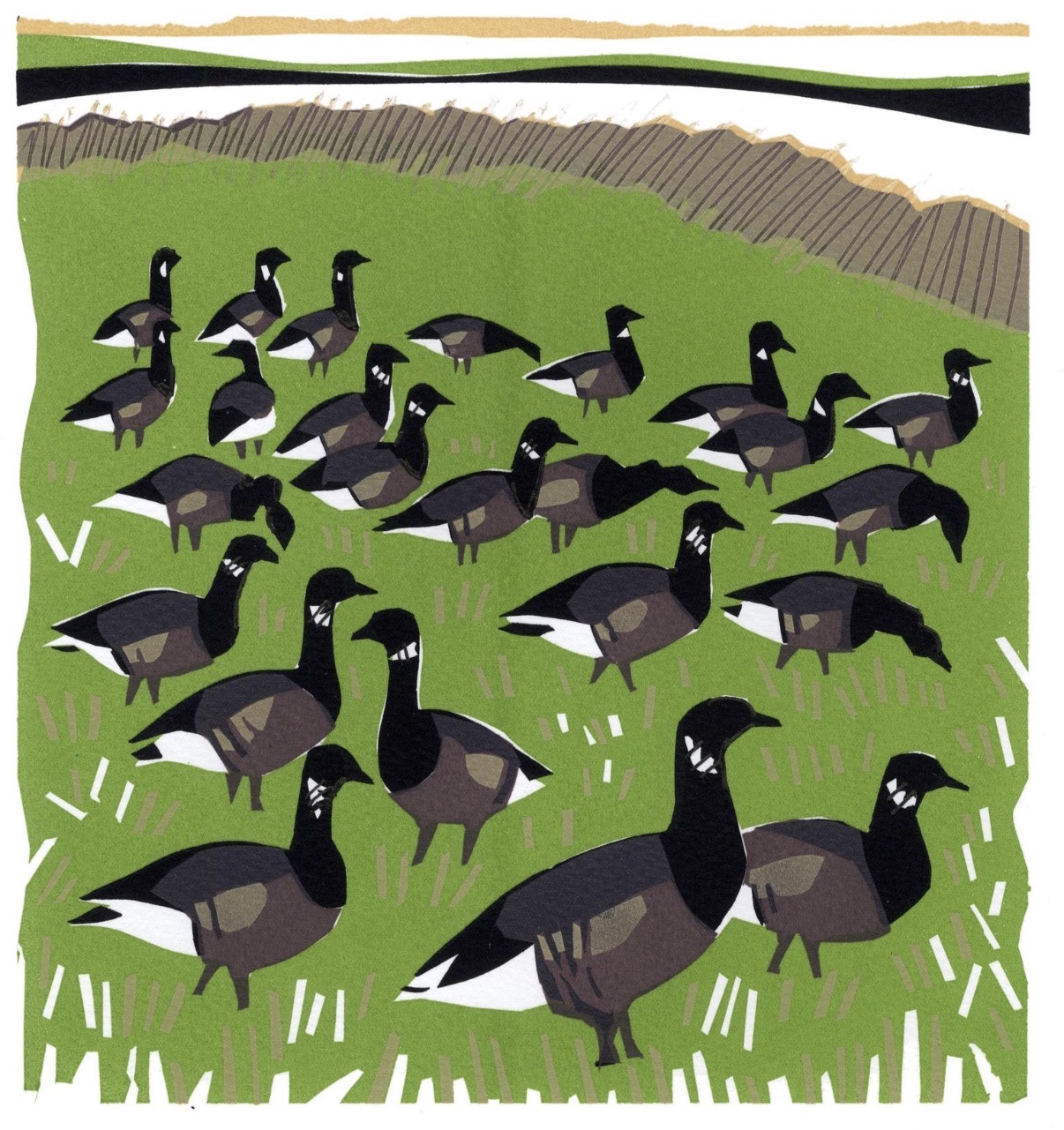
I had arranged to paint sea eagles snatching Barnacle Geese on Islay with wildlife photographer Jesse Wilkinson. It was a stormy day and my paper was being spattered by rain. Suddenly a young rabbit ran between me and my painting and I saw it was being pursued by a stoat (when I am sitting painting for any length of time I find animals and birds just see me as another object or rock on the landscape.) To get the rabbit, the stoat jumped onto my palette, right into a splodge of yellow ochre paint, used it as a springboard and landed on my painting, before jumping away into the grass. The result was my painting of birds joined with stoat paw prints in 60cm gaps. Amazingly, despite the wind and the rain, the birds weren’t smudged and I now had a completely original work, co-created with a stoat! I have had plenty of other close encounters with wildlife while working in the field – including thrushes hiding under my sketch pads to escape sparrow hawks. My piece in this year’s Annual Exhibition is a nice weathered one which I completed on the Isle of May observing sea birds.